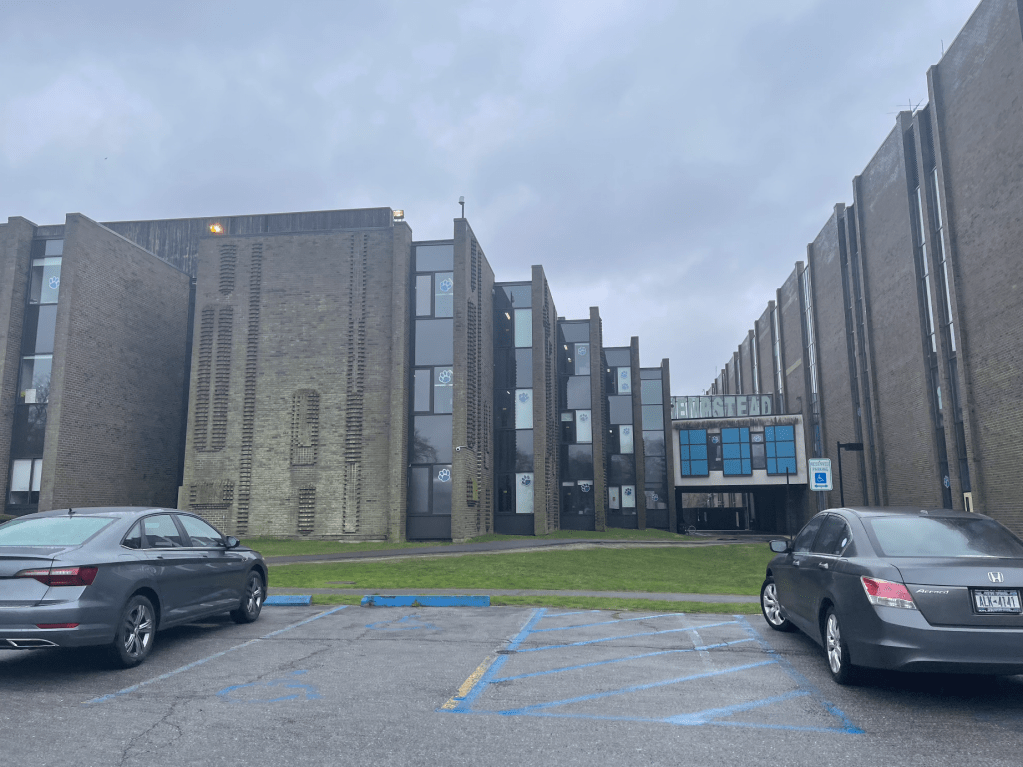
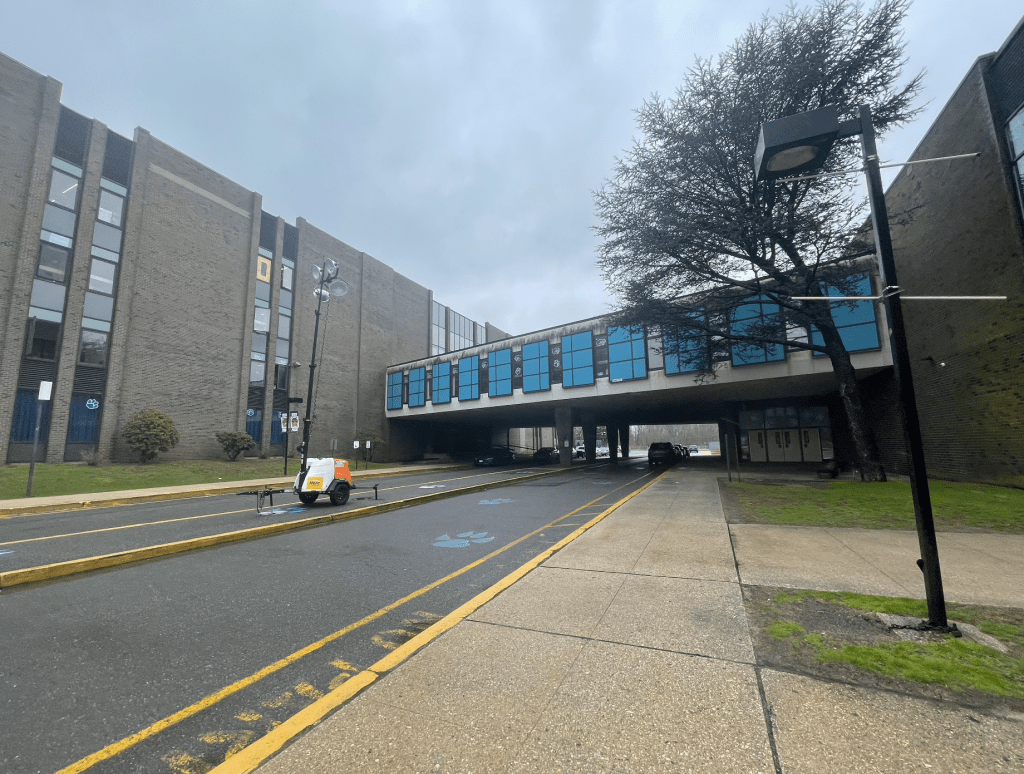
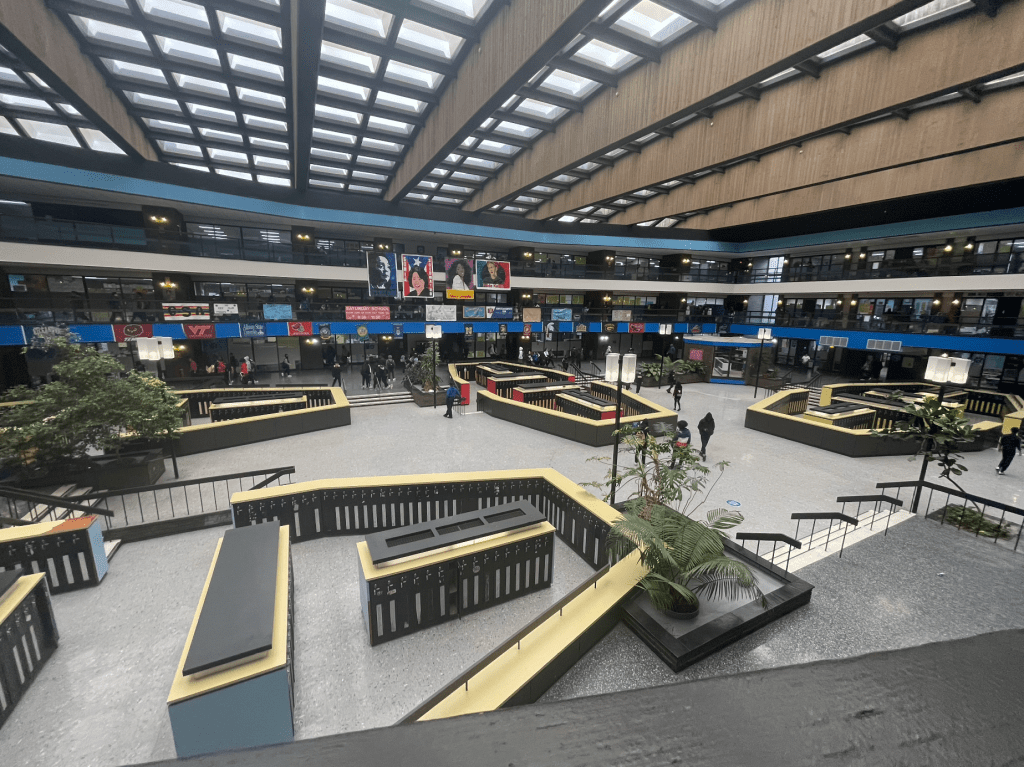
She got inside Hempstead High School after security searched through her belongings. The former student tried to walk towards her locker past a sea of over 2,500 students who looked like her. For the Honduran teenager, her friends were always Hispanic and Black — making up the majority of the student population.
Making her way past the chipped blue walls, a security guard was always posted at the end of every hallway to watch for potential fights.
“There were fights every single day and at that point, it didn’t even faze the security guards because there were so many,” she said.
When Figueroa would enter classrooms during her first two years, she would have to squeeze her way through over 35 students. That number dwindled as students would become involved in gang-related activities and drop out.
Lucky for Figueroa, she could see her rank going up as more students disappeared.
She took honors and three Advanced Placement classes during her time there. Only 12% of Hempstead students take at least one AP exam — only 6% pass.
After class, she would gear up for badminton and volleyball practices. There were days when her team would share run-down gymnasiums with others because of a lack of space.
Figuerora would find herself amazed at the “perfect uniforms” and brand new knee pads other teams would have. During away games, she remembers walking into a gymnasium and feeling the rush of cool air — something that her home gymnasium lacked.
Figueroa would return home and then get ready for her job at Planned Parenthood. This was one of her two jobs, which was a theme she frequently saw throughout Hempstead High School. About 72% of students at Hempstead High School are eligible for free lunch — an indicator of an economic disadvantage. As a first generation student, Figueroa felt she had to support herself.
She knew she was going to have to work hard to do what may come easy for students with more resources.
“There are so many students of color that have the same abilities,” she said. “But they never even understand that they even have those abilities because they never get a chance to express it.”
All that divides Figueroa and students with more resources is a running train track.

On one side of the tracks, you can find laundromats, bodegas and low-income housing. This side is home to a population that is 47% Hispanic, 45% Black and only 15% white. On the other side in the town of Garden City, you can find large department stores, a sea of trees and homes with multiple floors and drive-in driveways. Garden City has a population that is 89% white, 6% Hispanic and only 2% Black.
“Once you pass by Clinton Street and you see the trees, you see everything is so different,” Figueroa said. “I feel like it never clicked to me what was going on. When I was younger, I always thought Garden City just has more trees and that’s why it’s called that, but I didn’t really realize that it was systemic racism.”
Two towns right next to each other dramatically differ in environment, demographics and socioeconomic status, but it doesn’t stop there. It is also evident in education.
While Hempstead High School has a proposed budget of about $187M minus tuition from charter schools for its 2,174 students, Garden City High School proposes $122M as tuition for its 1,209 students. Although Hempstead receives more funding, it amounts to about $86K per student, while Garden City is set to receive about $100K per student. This money ultimately provides schools with curriculum options, Advanced Placement classes, facilities and funding for sports, extracurricular activities and an adequate number of teachers.
According to Niche’s grading system, Hempstead High School was given an overall grade of C-, while Garden City High School was given a grade of A+. Only 55% of Hempstead students graduate every year on average, while 99% of Garden City students have the opportunity to do so.
Marina Marcuo-O’Malley, the operation and policy director for the Alliance for Quality Education, has done work with Long Island’s schools and believes that various school districts in the region lack a quality education.
“A quality education means that students in schools and teachers have all the resources they need to reach the maximum of their potential and where a Black student and white student can have access to the same kind of resources, so that they can both go to college if they so choose,” Marcuo-O’Malley said.
Hempstead and Garden City tell the tale of educational inequity on Long Island.
Long Island is home to 10 of the 16 school districts in New York State that have 80% or more Black and Latino students. Not only are they racially segregated, with 93% of their students Black and Latino, but they are also economically segregated, as 70% of their students are economically disadvantaged.
“In Long Island, you see very, very, very clearly where the amount of access to college and career readiness you have is very much limited by where the train tracks cut off the district and that’s very true for many students,” Marcuo-O’Malley said.
Housing discrimination has perpetuated educational inequity on Long Island
In New York State, public education funding comes from federal sources, State aid and revenues raised locally, which includes local property taxes — showing the relationship between housing and school district funding. As communities of color are consistently steered towards the same towns, they find themselves restricted to a handful of school districts.
Housing patterns on Long Island have widened the income gap between the region’s 124 school districts. Poor districts like Hempstead, Uniondale and Roosevelt, have to tax themselves more than wealthier districts like Garden City, Old Westbury and Jericho, in order to raise the same amount of money.
Fred Freiberg, co-founder of the Fair Housing Justice Center, says fair housing laws have not been vigorously enforced and that’s still a major problem in the fact that housing discrimination persists to this day. Freiberg said the real estate industry continues to use private market discrimination, racial steering and other kinds of discriminatory zoning practices, thus creating constant barriers.
“We have to recognize that the foundation of our entire real estate industry had a racist beginning and that it was predicated on some assumptions of white supremacy,” Freiberg said. “And those have carried on to this day to one degree or another.”
The village of Garden City was involved in a yearslong lawsuit that ruled they discriminated against Black and Hispanic people by lacking fair and affordable housing options. The village was sued after approving a zoning classification that would have prevented multi-family housing from being built. The suit also forced Garden City to pay $5.3 million dollars in legal fees and relief, implement affordable housing requirements for all future building structures and join a group of Long Island municipalities that seek affordable housing funds. The village sought no funding through the group and left the Nassau County Urban Consortium the same month the court order expired.
“Garden City knew they were keeping people who are different from the residents who live in Garden City now by keeping out all affordable housing. This practice takes many shapes and forms in every community village,” Freiberg said.
Growing up as a Black woman on Long Island, Elaine Gross was never a stranger to housing discrimination. She always knew it was there. She saw it in the communities surrounding her. One day she asked herself why she kept continuously seeing discrimination happening again and again. She then got to work and whether it’s publishing research reports, undertaking litigation, advocating for policy changes or educating the public on the concept of structural racism — Gross can always be found working to end various types of discrimination.
Gross is the founder and president of ERASE Racism, a Long Island organization that works to promote racial equity in housing, education and community development.
As a champion for ending structural racism, she has led efforts that have amended and strengthened local fair housing laws. In a push for more “agressive identification of individuals and companies that are discriminating,” Gross hopes it will create concerns for those who are discriminating against people who don’t look like them.
While conducting research for her organization, Gross realized that the effects of housing discrimination were seeping into the public school system throughout the region. “Because housing is so connected, where you live is so connected to where you go to school,” Gross said.
She believes the availability of affordable housing on Long Island is connected to where a student attends school. “We know that Black and Brown students for the most part, do not have access to the same AP courses,” Gross said. “The reason for that is because most of the Black and Brown students are going to intentionally segregated schools and those are the school districts that are lacking in AP courses.”
In addition to AP courses, students who attend under-resourced schools don’t have access to various sports, extracurricular activities, college preparation resources and an overall excellent quality of education.
While Hempstead students have an average SAT score of 1020, Garden City students have an average score of 1300. Figueroa, who was friends with the valedictorian of Hempstead High School, said she remembers her friend telling her there were not enough AP classes because she would see other college students who she was competing against, and their averages were always “way above” because of the fact that they have so many other AP courses.
Charter schools were created to help promote improvements in public education by increasing competition among schools. Marcuo-O’Malley said they were also created to be places of innovation but ended up negatively affecting funding for public schools and often diverting resources from them as well.
“That was another way of perpetuating inequities because if the State wanted to create something, they should have funded it already on its own without making parents compete against parents and students compete against students,” she said.
Sheilly Martinez, a 19-year-old sophomore political science major at Stony Brook University, grew up in Hempstead and still lives in an apartment complex with seven other family members. In Hempstead, about 64% of housing is apartments, while in Garden City, only 17% is apartments.
Martinez attended public school up until the eighth grade when her parents didn’t want her to go to Hempstead High School due to its size, constant fights and ultimately, its reputation.
“My parents just didn’t want to put me on a wrong path because usually in high school, kids start to hang out with certain crowds,” Martinez said. “I also feel like it does get a bad reputation because there are students who do go on to these amazing schools from Hempstead and I feel like they also don’t really tend to get the recognition.”
For high school Marintez attended one of Hempstead’s charter schools — the Academy Charter School. Even though it is competitive, since funding was being taken from the already limited funding that Hempstead receives, Martinez felt her charter school still lacked resources. She said the school didn’t have many AP classes and many teachers didn’t understand that a lot of kids came from low-income backgrounds.
“A quality education includes some very basic stuff like adequate number of teachers and a culturally responsive and sustaining curriculum in every school where students can feel welcomed and see a reflection of themselves, their culture and of their history within the teachings of the school,” Marcuo-O’Malley said.
65 years after Brown v. Board of Education, segregation thrives on Long Island today
Just like Hempstead and Garden City, most schools on Long Island follow the same trend where two towns right next to each other differ greatly by race, socioeconomic status and schools.
“Honestly, Garden City people just don’t even want to be associated with Hempstead people at all and I feel like that’s the same way towards people who live in Hempstead towards Garden City, because they drew that barrier long ago,” Martinez said.
That barrier was drawn when lines in housing were drawn.
In the 1940’s and 50’s, the practice of blockbusting exploded on Long Island, in which real estate agents would warn homeowners that Black homebuyers were coming and would thus as a result, lead to property values plummeting. Another discriminatory practice of redlining, or the practice of not granting mortgage credit to communities of color or making mortgage credit more expensive for communities of color, was also persistent in the region. This practice created maps that drew red lines around neighborhoods and expanded segregation among towns.
More recently, a 2019 Newsday investigation revealed that racial steering is also very evident across the region. The report found “evidence of widespread separate and unequal treatment of minority potential homebuyers and minority communities on Long Island.” Black testers experienced unequal treatment 49% of the time, compared with 39% for Hispanics and 19% for Asian testers. White testers were often steered away from majority Black and Hispanic towns like Hempstead, Elmont, Roosevelt, Baldwin and Freeport.
This ongoing selective placement of communities of color seeps into schools, making it hard to desegregate schools on Long Island.
Jacob Faber, an assistant professor of sociology at New York University, said because regions are segregated by race and by income, the uneven distributions of both interact to create a pathway from segregation to inequality.
“If you live in a rich area, you’re going to have rich schools and if you live in a poor area, you’re going to have poor schools,” he said. “That then feeds back into the housing market to inflate house prices of homes in already expensive areas and decrease house prices of the homes in already depreciated areas, and this is a cycle that reinforces itself over time.”
The segregation that housing has caused doesn’t allow for school integration. According to the National Coalition on School Diversity, children who attend economically and racially integrated schools have improved achievement, are more likely to grow up and live in integrated communities and neighborhoods and ultimately send their own children to integrated schools.
School districts have also opposed affordable housing by placing strict district lines that use where a person lives to determine which school district they will attend. Ian Wilder, the executive director of Long Island Housing Services Inc., said school district lines often based on racial segregation lines leads to districts with the most resources, the best reputations and the best access, being the ones that don’t serve communities of color.
“In terms of school districts interfering in housing decisions, that’s not their job,” Wilder said. “Their job is to educate every child in their district, period. Not to try and find ways to keep them out. Whether it’s keeping them out by having unnecessary forms to try and prove that they live there, especially to children whose parents are renting, or to try and keep out affordable housing from their districts, that is not their place.”
Figueroa believes students shouldn’t have to worry about their education because of the color of their skin or where they grew up. “In our times, the fact that we could still pick and choose towns out like that is ridiculous,” she said.
Dr. Lorna Lewis is the superintendent of the Malverne Union Free School District — a district that defies the odds. Malverne School District has a student population that is 46% Black, 27% Hispanic and 18% white. Although it has similar demographics to Hempstead, Malverne receives adequate funding and is high performing.
With preparation for college and a rich array of courses, Lewis said Malverne “fights like hell to keep our kids from going away to private school at the end of the eighth grade.” The same way Martinez didn’t attend Hempstead High School and went to charter school instead, Lewis said many white students switch to a private school because they want as many resources as possible.
She also said stability on the school board and administration is vital.
“Malverne has had a stable board, a board that believes in education,” she said. “You have a community, despite the fact that many of them will not come to our schools. They still support our district and our budget.”
People of color were hindered from owning homes on Long Island
White picket fences, rolling green lawns, swimming pools and look-alike homes — this was and still is Levittown, which became the blueprint for suburbia in the 1950’s. What may be the “American dream” to some, wasn’t for all.
Levittown was built for returning World War II veterans — as long as they weren’t a person of color. A clause in the town’s covenant prevented tenants from allowing non-Caucasians to use or occupy Levitt houses. The town justified it by stating that it maintained the value of the properties since the white community preferred not to live in mixed communities.
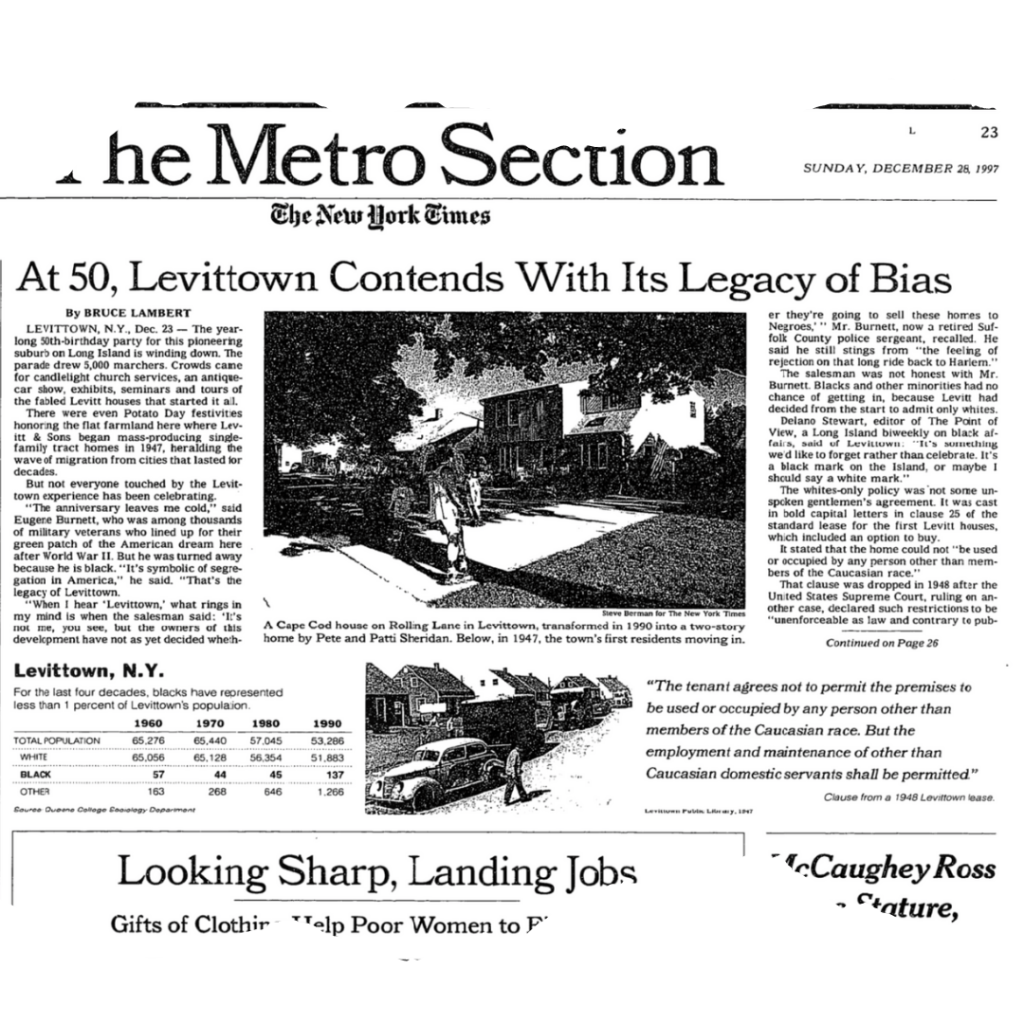
Theresa Sanders, president of the Urban League of Long Island Incorporated, remembers the story her parents told her of their journey to buy a home on Long Island following the war. When her parents were reading newspapers and going to open houses looking for a home after her father was being discharged, the couple was told Levittown wasn’t for them. Her parents then moved into West Babylon and when hearing that story, Sanders learned Long Island was “purposely designed that way.”
When her family eventually moved to East Meadow, Sanders recalls being the only student of color in her class. “We were in a culture shock coming from New York City to Long Island,” she said.
Even though that was more than 70 years ago, Levittown currently has a population that is about 83% white, 16% Hispanic and only 1% Black. Those same demographics translate to Levittown’s schools, which have two high schools available to students.
“There’s a deliberate attempt to steer people to certain communities,” Sanders said. “And if you don’t have the power to find your own home, you live where people tell you to live.”
Advocates push for change to reach educational equity and school desegregation
While only eight percent of all Long Island students attend high need districts, 91% of the students in those high need districts are Black or Hispanic, according to an investigative report from last year. School districts that predominantly serve students of color received $23 billion less in funding than mostly white school districts in the United States in 2016, despite serving the same number of students.
Housing and education experts and social justice advocates are pushing for change so that Long Island schools can reach a level of equity.
Janel George is the director of the Racial Equity in Education Law and Policy Clinic at Georgetown Law, and her work mainly focuses on inequality in U.S. education and the resegregation of public schools. She said she wants to urge that school integration isn’t just about the movement of bodies, but the equalization of resources and experiences that students would have.
Podcast Episode:
A Few Miles Away, But Two Worlds Apart
the director of the Racial Equity in Education Law and Policy Clinic at Georgetown Law.
“It’s the systemic policies and intentional under-resourcing of the school and districts attended by students of color in areas of concentrated poverty that perpetuates segregation and negative educational outcomes for those students,” George said.
George said there is a large amount of evidence to support the promotion of school desegregation.
“We need to do something about these school districts and the school district lines,” Wilder said. “And that’s one of the things that hasn’t changed. We haven’t made changes in terms of home rezoning. We haven’t made changes in terms of school district lines. We haven’t made changes in terms of school district funding. We have systemic racism and it exists in every part of our society.”
 Maya Brown